Offshore green hydrogen
Wind-powered electrolysis and hydrogen buffering linked to LH₂ shipping or pipeline export, with opt-in research modules for compressed-H₂ shipping and ammonia carriers, studied as one coupled system.
Owais Ahmad · Engineer & researcher
I research renewable energy and hydrogen systems, and build the software to understand how they perform in the real world.
PhD Candidate · Mechanical Engineering
University of Victoria · British Columbia, Canada
Research focus
My work connects physical models, long weather records and optimization, so that design decisions account for when energy is available, where it can be stored and how it can be moved.
Wind-powered electrolysis and hydrogen buffering linked to LH₂ shipping or pipeline export, with opt-in research modules for compressed-H₂ shipping and ammonia carriers, studied as one coupled system.
Dispatch and sizing of renewable, storage and diesel microgrids, comparing forecast-informed model predictive control with conventional load-following.
Batteries, underwater compressed-air storage and hydrogen inventories: when storage improves reliability or cost, and when it does not.
Multi-objective design with NSGA-II/III, mixed-integer dispatch, sensitivity and Monte Carlo analysis, and year-to-year weather variability.
C++ and Python simulation platforms with conservation checks, regression tests and recorded provenance, so that results can be rerun and audited.
An electrical power-systems background and more than three years designing, commissioning and maintaining commercial solar-PV installations.
Built for research
OffshoreLH2 brings wind, hydrogen production, storage, shipping and delivered cost into one chronological research platform.
Explore OffshoreLH2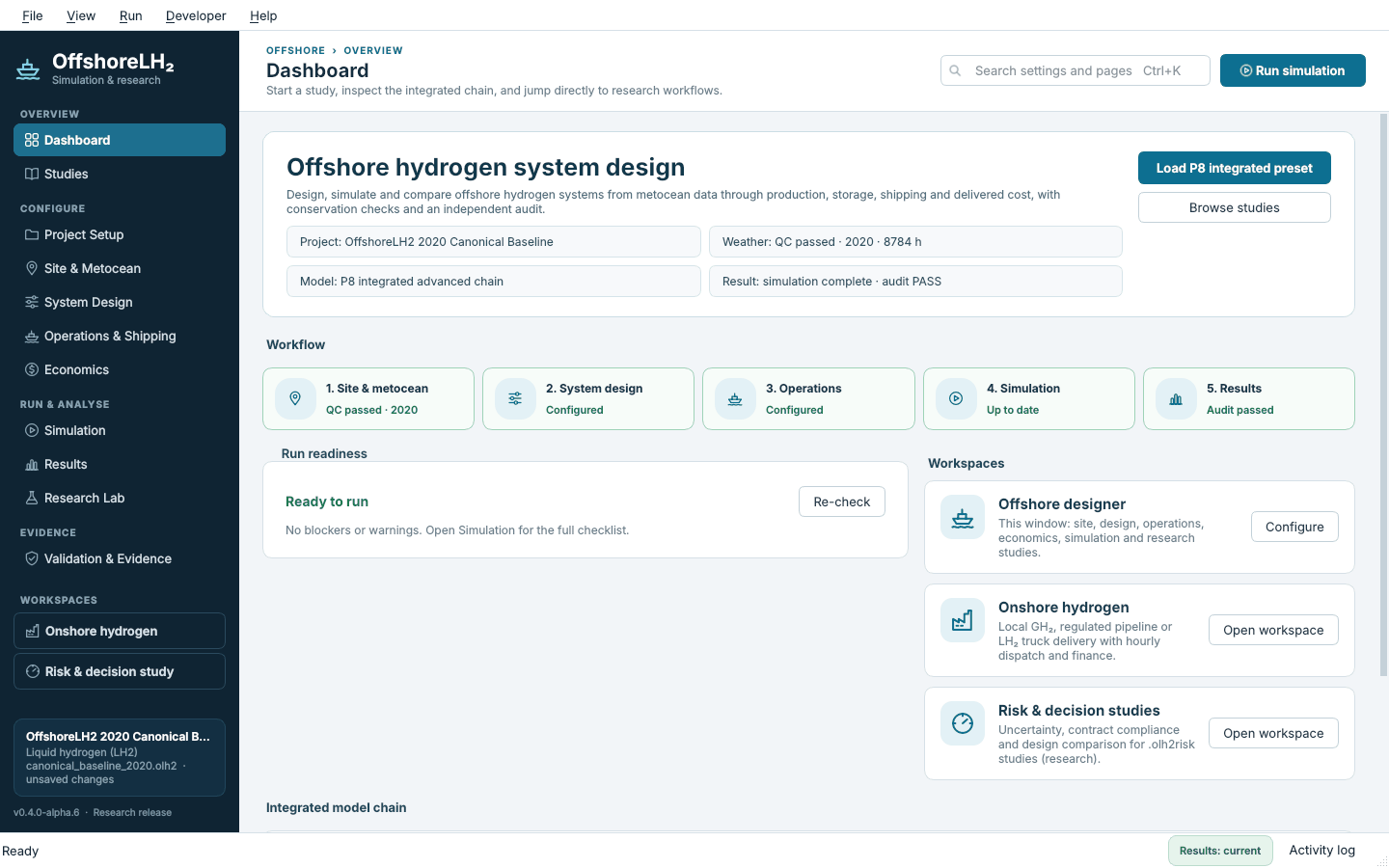
A deterministic C++20 core connects wind, electrolysis, storage, liquefaction and export, with hourly energy and mass balances.
Every run records its configuration, weather-data hash and software version. Sensitivity, Monte Carlo and design optimization build on the same engine.
The desktop candidate includes a separate onshore workspace. Microgrid integration and a unified model remain planned.
H2 Intelligence roadmapSelected publication · 2026
Eleven years of hourly ERA5 data for a North Atlantic and a North Sea site, an hourly production, storage and vessel model, and tri-objective optimization show how wind–wave transfer limits shape offshore hydrogen design. Performance responds sharply when those limits are strict and levels off as transfer capability improves; the selected North Atlantic design reached US$8.53/kg, against US$11.78/kg for the North Sea design.
Background
Engineering practice came first: system sizing, single-line diagrams, procurement and commissioning. It still shapes how I model systems today.
University of Victoria
Faculty of Engineering and Computer Science, UVic
University of Victoria
Voltric Energy (Pvt.) Ltd., Peshawar
Huawei Technologies, Pakistan
University of Victoria · candidacy passed April 2025
University of Engineering and Technology, Peshawar
UET Peshawar · graduated with distinction
Let’s connect
I welcome conversations about research collaboration, evaluating OffshoreLH2, and engineering or research roles in renewable energy and energy-system modelling.